
Perimenopause and menopause change far more than your cycle. As oestrogen levels shift, you may notice changes in your strength, your joints, your sleep, your pain and your mood, sometimes all at once.
The good news is that much of this is understood, and much of it is responsive to the right kind of movement and support. As a physiotherapist, here are five things I want every woman to know about her body during this transition.
 1. Your muscles need more attention than ever
Oestrogen helps protect muscle. As it declines through the menopause transition, women tend to lose muscle mass more quickly and gain fat, particularly around the abdomen. Research suggests this shift is driven by the hormonal change itself, not simply by getting older (Greendale et al 2019).
Longitudinal studies suggest muscle loss may reach approximately 1 to 1.5 per cent per year during this period, alongside a rise in deeper abdominal (visceral) fat (El Khoudary et al 2020). Over time, this can lower your resting metabolism, make everyday tasks feel harder and raise your risk of heart and metabolic disease.
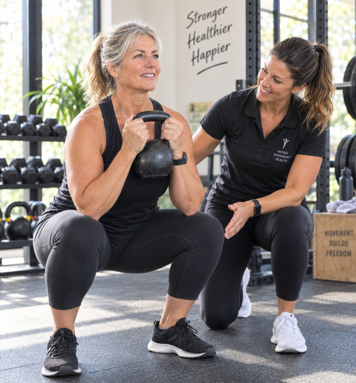
How physiotherapy helps: We can pick up early signs of strength loss and build a progressive resistance program that suits your body, your history and your goals. Strength training during and after menopause can help maintain or even build lean muscle and function (Sipilä et al 2020). Add in balance and functional work, and you are also investing in your future independence by lowering your risk of falls and frailty.
2. Your bones are changing quietly
Bone is living tissue, constantly being broken down and rebuilt. After menopause, falling oestrogen tips that balance, so bone is lost faster than it is replaced.
In the five to seven years after menopause, women can lose up to approximately 20 per cent of their bone density (Greendale et al 1997, National Institutes of Health 2023). That raises the risk of osteoporotic fractures, most often in the spine, hip and wrist, which can mean ongoing pain and a loss of independence.
How physiotherapy helps: Perimenopause is the ideal time to act. Weight-bearing and resistance exercise can slow bone loss and strengthen the skeleton, especially when started early (Watson et al 2015). Your physio can also work on balance, posture and falls prevention.
3. Achy joints and sore tendons are not “just ageing”
If your shoulders, hips or knees have started to complain, you are far from alone. Researchers now describe a “musculoskeletal syndrome of menopause”, and it is thought to affect more than approximately 70 per cent of women (Wright et al 2024).
Oestrogen helps your body make collagen, the protein that gives tendons and ligaments their strength and spring. With less of it, these tissues can become stiffer, drier and less able to handle load, making them more prone to small tears, tendon pain and joint instability (Chidi-Ogbolu & Baar 2019, Frizziero et al 2014). Healing can also slow down (Frizziero et al 2014).
How physiotherapy helps: Tendons and ligaments respond well to the right dose of load. A targeted program of strength, mobility and stability work can help keep them healthy (Cowan et al 2022). Menopausal hormone therapy may also play a role for some women, but this needs an individual conversation with your doctor (Calleja-Agius & Brincat 2009).
4. Poor sleep can turn up the volume on pain
Night waking, hot flushes and lying awake at 3am are some of the most common complaints of perimenopause and menopause. What many women do not realise is that broken sleep does more than leave you tired. It can make your nervous system more sensitive to pain.
A 2022 systematic review and meta-analysis of 31 experimental studies found that losing sleep lowered people’s pain thresholds and tolerance, and that fragmented sleep increased signs of sensitisation in the nervous system (Chang et al 2022). Another 2022 review concluded that inadequate sleep specifically heightens pain sensitivity, and that interrupted sleep appears to weaken the body’s own pain-dampening system, especially in women (Kourbanova et al 2022).
This matters for women in midlife. In a study of postmenopausal women with chronic musculoskeletal pain, sleep problems were a stronger predictor of next-day pain than pain was of poor sleep (Frange et al 2019). In other words, that new ache in your hip or neck may not mean something is damaged. Your pain system may simply be running on high alert.
How physiotherapy helps: Understanding pain is powerful in itself. A pain-informed physiotherapist can help you make sense of what you are feeling, settle a sensitised nervous system and build activity back up at the right pace. Regular exercise, a consistent wind-down routine and addressing hot flushes or night sweats with your GP can all support better sleep, and better sleep can mean less pain.
5. Your mind and mood matter to your recovery
Changing hormones can affect how you feel as much as how you move. Anxiety, low mood, irritability, fatigue and the frustrating “brain fog” are all common during the transition (Greendale et al 2010, Hogervorst et al 2022), and falling oestrogen is thought to play a part (Freeman 2015).
These changes can affect your rehab too. Trouble with focus and memory can make it harder to learn new exercises (Hogervorst et al 2022), while fatigue can lower your tolerance for activity (Saghafi et al 2021). Anxiety and depression in menopause have also been linked with poorer physical function and less motivation to move (Thurston et al 2008).
How physiotherapy helps: A good physio will notice when mood, energy or concentration are affecting your progress, and adjust your program so it feels achievable. Exercise remains one of the best tools we have, with evidence supporting its benefits for both mood and thinking (de Rezende et al 2014). Physiotherapy works best as part of a team, so we will happily work alongside your GP, psychologist or other health professionals.
You do not have to just push through
Perimenopause and menopause are a natural stage of life, but struggling through them is not a rite of passage anymore. With the right information and support, you can stay strong, active and confident in your body for decades to come.
Two things make a real difference. The first is a GP who keeps up to date with current menopause research, so your medical options are fully explored. The second is a physiotherapist who understands how changing hormones affect your muscles, bones, joints, sleep and pain.
It is also worth revisiting what you may have heard about hormone therapy, now usually called menopausal hormone therapy (MHT). In 2002, a large US study called the Women’s Health Initiative reported risks that were widely publicised and then generalised to almost all women, and many stopped or avoided treatment as a result. Later reanalysis showed the picture is far more reassuring than those early headlines suggested.
Current evidence indicates that for most healthy women who start MHT within 10 years of menopause, or before age 60, the benefits generally outweigh the risks. In November 2025, the US Food and Drug Administration removed most of the long-standing “black box” warnings from these medicines, recognising that the earlier warnings did not reflect the full evidence (Obstetrics & Gynecology 2026). Sadly, the fear created two decades ago still shapes public opinion today. MHT is not right for everyone, so talk it through with a menopause-informed GP who can weigh up your personal history.
At Sunshine Coast Health Services, we are passionate about helping women understand their bodies through this time of change. If any of this sounds familiar, we would love to help you feel like yourself again.
This post was inspired by the Australian Physiotherapy Association’s article on physiotherapy and menopause.
References
- Calleja-Agius, J., & Brincat, M. P. (2009). Effects of hormone replacement therapy on connective tissue: Why is this important? Best Practice & Research Clinical Obstetrics & Gynaecology, 23(1), 121–127. https://doi.org/10.1016/j.bpobgyn.2008.10.003
- Chang, J. R., Fu, S. N., Li, X., Li, S. X., Wang, X., Zhou, Z., Pinto, S. M., Samartzis, D., Karppinen, J., & Wong, A. Y. L. (2022). The differential effects of sleep deprivation on pain perception in individuals with or without chronic pain: A systematic review and meta-analysis. Sleep Medicine Reviews, 66, 101695. https://doi.org/10.1016/j.smrv.2022.101695
- Chidi-Ogbolu, N., & Baar, K. (2019). Effect of estrogen on musculoskeletal performance and injury risk. Frontiers in Physiology, 9, 1834. https://doi.org/10.3389/fphys.2018.01834
- Cowan, R. M., Ganderton, C. L., Cook, J., Semciw, A. I., Long, D. M., & Pizzari, T. (2022). Does menopausal hormone therapy, exercise, or both improve pain and function in postmenopausal women with greater trochanteric pain syndrome? A 2 × 2 factorial randomized clinical trial. The American Journal of Sports Medicine, 50(2), 515–525. https://doi.org/10.1177/03635465211061142
- de Rezende, L. F. M., Lopes, M. R., Rey-López, J. P., Matsudo, V. K. R., & do Carmo Luiz, O. (2014). Sedentary behavior and health outcomes: An overview of systematic reviews. Maturitas, 79(4), 411–418. https://doi.org/10.1016/j.maturitas.2014.01.019
- El Khoudary, S. R., Aggarwal, B., Beckie, T. M., et al. (2020). Menopause transition and cardiovascular disease risk: Implications for timing of early prevention: A scientific statement from the American Heart Association. Journal of the American Heart Association, 9(9), e013219.
- Elimination of the black box warning on menopausal hormone therapy. (2026). Obstetrics & Gynecology, 147(5), 642–646. https://doi.org/10.1097/AOG.0000000000006226
- Frange, C., et al. (2019). Temporal analysis of chronic musculoskeletal pain and sleep in postmenopausal women. Journal of Clinical Sleep Medicine. https://pmc.ncbi.nlm.nih.gov/articles/PMC6374090
- Freeman, E. W. (2015). Associations of depression with the transition to menopause. Journal of Steroid Biochemistry and Molecular Biology, 142, 155–161. https://doi.org/10.1016/j.jsbmb.2013.09.008
- Frizziero, A., Vittadini, F., Gasparre, G., & Masiero, S. (2014). Impact of oestrogen deficiency and aging on tendon: Concise review. Muscles, Ligaments and Tendons Journal, 4(3), 324–328.
- Greendale, G. A., Derby, C. A., & Maki, P. M. (2010). Perimenopause and cognition. Obstetrics and Gynecology Clinics of North America, 37(3), 519–535. https://doi.org/10.1016/j.ogc.2010.06.002
- Greendale, G. A., Huang, M. H., Karlamangla, A. S., et al. (2019). Changes in body composition and weight during the menopause transition. Journal of Gerontology: Medical Sciences, 74(4), 489–495.
- Greendale, G. A., & Sowers, M. F. (1997). Bone mineral density loss in relation to the final menstrual period in a multiethnic cohort: Results from the Study of Women’s Health Across the Nation (SWAN). Annals of the New York Academy of Sciences, 828, 63–80.
- Hogervorst, E., Craig, J., & O’Donnell, E. (2022). Cognition and mental health in menopause: A review. Maturitas, 164, 1–7. https://doi.org/10.1016/j.maturitas.2022.05.002
- Kourbanova, K., Alexandre, C., & Latremoliere, A. (2022). Effect of sleep loss on pain: New conceptual and mechanistic avenues. Frontiers in Neuroscience, 16, 1009902. https://doi.org/10.3389/fnins.2022.1009902
- National Institutes of Health. (2023). Osteoporosis and Related Bone Diseases National Resource Center. https://www.bones.nih.gov
- Saghafi, R., Gharraee, B., Rahmani, S., & Shariat, A. (2021). Menopause, sleep quality, and health-related quality of life: The role of physical activity. Menopause, 28(8), 937–944. https://doi.org/10.1097/GME.0000000000001793
- Sipilä, S., Multanen, J., Kallinen, M., et al. (2020). Effects of strength and balance training on muscle strength and bone mineral density in postmenopausal women: A randomized controlled trial. Ageing Research Reviews, 62, 101073.
- Thurston, R. C., Joffe, H., Soares, C. N., & Harlow, B. L. (2008). Physical activity and risk of vasomotor symptoms in women with and without depression. The Journals of Gerontology Series A: Biological Sciences and Medical Sciences, 63(8), 767–773. https://doi.org/10.1093/gerona/63.8.767
- Watson, S. L., Weeks, B. K., Weis, L. J., et al. (2015). High-intensity exercise for bone health in postmenopausal women with low bone mass: A randomized controlled trial. Osteoporosis International, 26(2), 521–529.
- Wright, V. J., Schwartzman, J. D., Itinoche, R., & Wittstein, J. (2024). The musculoskeletal syndrome of menopause. Climacteric, 27(5), 466–472. https://doi.org/10.1080/13697137.2024.2380363